
About us
The Our Trees project
(Trees4All)
grew out of a wish to make planting trees and caring for naturesomething all of us take part in, in a way that also works for the communities doing the planting
Weconnect the moneyfrom businesses and from people far from the forest who want to look after nature
to the farmers who plant the trees, to restore or repair the environment where they live,
while raising incomes and improving life in the community,
and then report back on what that shared effort has changed,
through the tree tracking system at trees4allthailand.org
Our Trees is run by RECOFTC, an international non-profit that has worked since 1997 towards a future where people and forests live together, alongside partner organisations including the Our Trees community enterprise group in Nan province, where the project began.
Why it matters
From farmers in the Nan headwaters
to people in the city
Why it matters
From farmers in the Nan headwaters
to people in the city
Nan provincehas some of the most forest of any province in Thailand — 4.394 million rai, 60% of its area. But over the past ten years 1.664 million rai of ithas been degraded, as demand from the animal feed industry pushed farmers into single crops…
all while the climate grows less predictable. Farmers want to move to something more sustainable; what stops them is the capital, and the uncertainty of earning from anything else. That is as true in Santi Suk district and around Doi Phu Kha National Park as anywhere. These are the headwater forests that feed more than 40% of the Chao Phraya, the river city life depends on. When things go wrong upstream, they are felt downstream too.

Once the maize is in, the buyers come right to the farm. And so it turned out that our Santi Suk district became the maize capital — a compliment that stings. Nobody plants and tends trees better than these farmers. The question is how to get them started, and confident that once the trees are in, it will help them, help society and help the planet. Planting the old way built neither confidence nor change, so we had to find a mechanism that fits.
Plant. Track. Transform.
Donating or volunteering to plant trees is a popular answer in Thailand. But until now, nobody could say where those trees ended up, or how they were doing.
RECOFTC Thailand therefore joined farmers in the Nan headwaters and partner organisations to start Our Trees in 2022, raising funds for planting that can actually be followed.
What we buy and how we live is part of what decides which crops a farmer plants, so the responsibility for restoring the environment is shared. “Our Trees” is built so that people far from the forest can work with the farmers beside it: their donation becomes the capital a farmer needs to plant a mix of species into worn-out monoculture land, and both can follow the change online.
“Our vision”
“Changemust not stop at a number of trees. People’s lives get better too, with those near the forest and those far from it (business included) solving the problem together.”
We started in Nan,but we want trackable tree planting to becomea model for caring for the environment and backing farmers elsewhere as well.
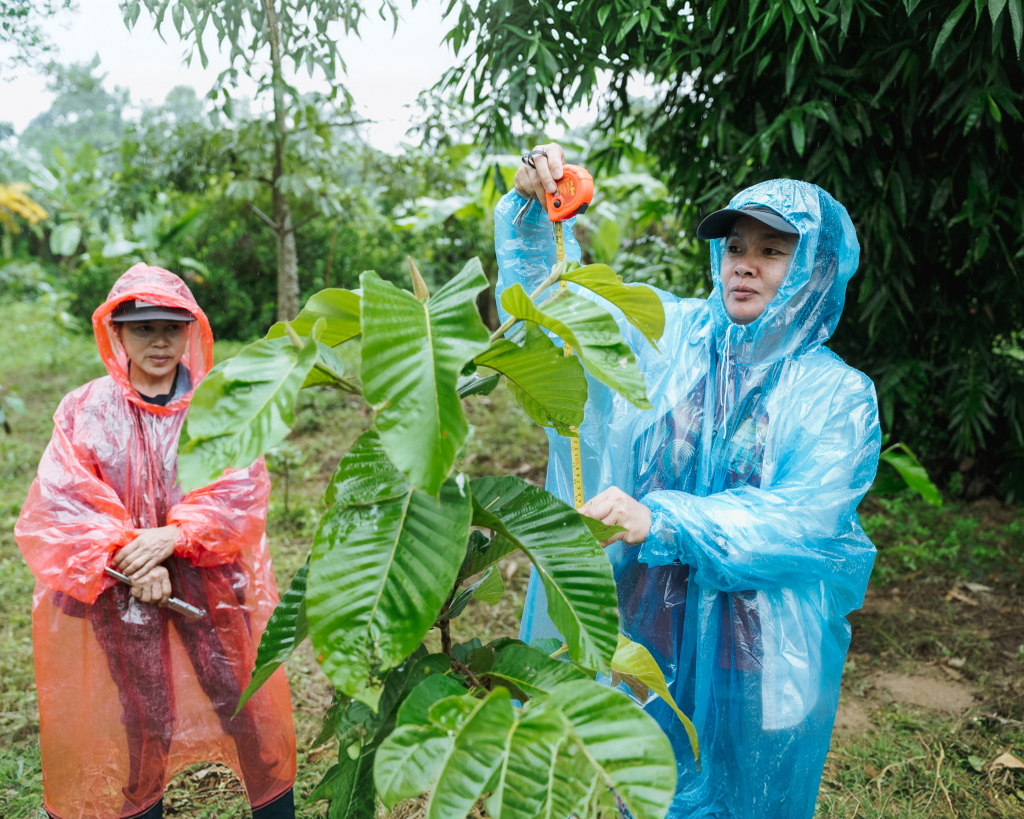
Our Trees builds skills and knowledge with local farmersto design how each plot is managed and choose the trees that suit what farmers in that area actually need.
Follow
how we have grown
2565
Sowing the seeds of change: “Our Trees”
- Our Trees starts in Santi Suk district, Nan province, in February, funded by the Global EbA Fund and the Wyss Academy for Nature.
- Phase 1 fundraising opens.
- 33 farmers join and are trained in designing planting plots and tracking trees with simple scientific tools.
- The first year closes with over 400,000 baht donated and 400 trees planted.
2566
The tree tracking system launches
- The tracking system goes live at trees4allthailand.org in March.
- Santi Suk farmers form the Our Trees community enterprise group, to build businesses on the back of the planting and run the work locally, with RECOFTC Thailand helping them prepare.
- Donors’ confidence carries the total past 1,000,000 baht.
2567
Growing into regenerative agriculture
- Farmers train to take the planting further into agroforestry — farming that restores soil and nature by bringing trees, other plants and animals into the same plot, so the system resembles a forest, biodiversity rises, and incomes grow.
2568
Results start reaching supporters
- Phase 2 fundraising opens and the work spreads to other districts around Doi Phu Kha National Park, including ethnic minority communities.
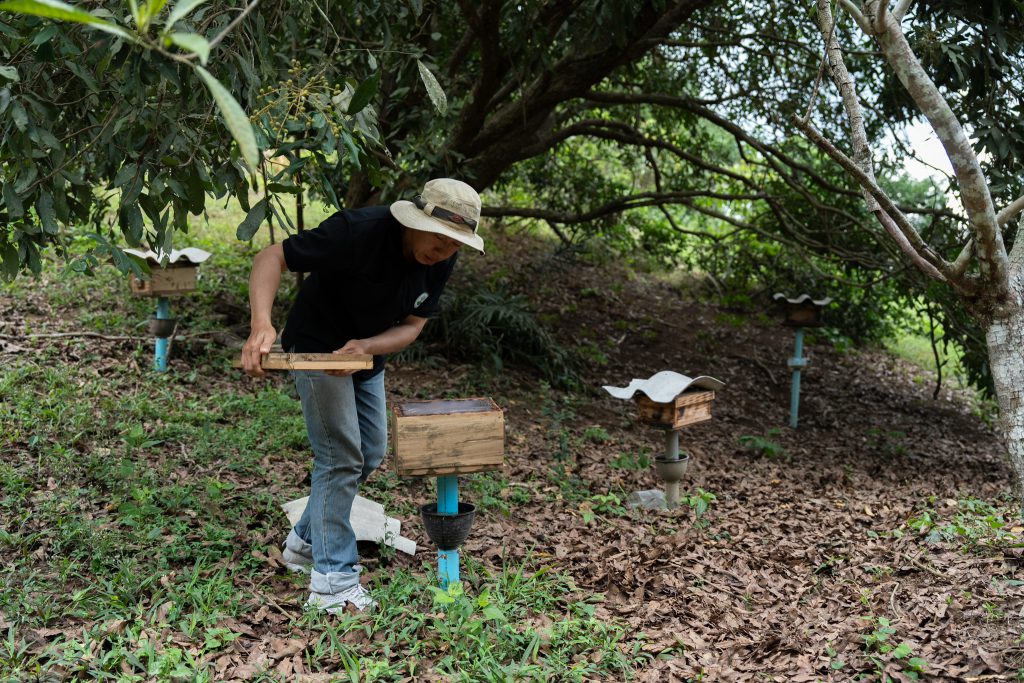
- Pilot farmers begin keeping stingless bees and goats, and growing ground cover such as beans and herbs among the trees.
- The community enterprise group’s leaders train in running the enterprise.
- The group trials stingless bee honey soap — the first product to come out of restoring the headwaters, sent back downstream to the people who funded the work.
2569
Preparing to scale
- Phase 3 fundraising opens.
- Preparing to take the work beyond Nan.
2565
2566
2567
2568
2569
Sowing the seeds of change: “Our Trees”
- Our Trees starts in Santi Suk district, Nan province, in February, funded by the Global EbA Fund and the Wyss Academy for Nature.
- Phase 1 fundraising opens.
- 33 farmers join and are trained in designing planting plots and tracking trees with simple scientific tools.
- The first year closes with over 400,000 baht donated and 400 trees planted.
The tree tracking system launches
- The tracking system goes live at trees4allthailand.org in March.
- Santi Suk farmers form the Our Trees community enterprise group, to build businesses on the back of the planting and run the work locally, with RECOFTC Thailand helping them prepare.
- Donors’ confidence carries the total past 1,000,000 baht.
Growing into regenerative agriculture
- Farmers train to take the planting further into agroforestry — farming that restores soil and nature by bringing trees, other plants and animals into the same plot, so the system resembles a forest, biodiversity rises, and incomes grow.
Results start reaching supporters
- Phase 2 fundraising opens and the work spreads to other districts around Doi Phu Kha National Park, including ethnic minority communities.
- Pilot farmers begin keeping stingless bees and goats, and growing ground cover such as beans and herbs among the trees.
- The community enterprise group’s leaders train in running the enterprise.
- The group trials stingless bee honey soap — the first product to come out of restoring the headwaters, sent back downstream to the people who funded the work.
Preparing to scale
- Phase 3 fundraising opens.
- Preparing to take the work beyond Nan.
RECOFTC supporters

Our Trees (Trees4All) supporters

Implementing and partner organisations


Join us in planting our trees
to grow a future where nature, communities andall of us grow together